

Khyati Sanger discovered her love for writing on a rainy day at the age of eight. She’d been waiting to go out and play when her mother called her. “She wanted to challenge me to write poetry,” she reminisces. Her first poem, written that day, was about photosynthesis.
Today, Khyati is a storyteller, with a Bachelor’s in English Literature, pursuing a Master’s in Journalism from Indian Institute of Mass Communication. While her work has appeared on platforms like Hindustan Times (2021), Economic Times (2020), MensXP (2019), WhatsHot (2019) and more, she has now moved on to pursue a career in fiction. “What I like about fiction is that there is a lot you can do to convey a message impactfully. This becomes difficult in using real-life evidence,” she says.
Over a telephonic conversation, we got down to talking about what it’s like for a fiction writer to enter the world of hard journalism, and what makes them leave it behind. Here’s how Khyati has come to discover the mutual inclusivity of the two fields.
INTERVIEWER
Why did you choose to work in hard journalism?
KHYATI SANGER
I thought I couldn’t make a sustainable profession out of creative writing, unless I made a recognisable name in the industry. I decided to earn off of being a journalist and keep pursuing storytelling alongside. I started interning in journalism in the first year of my Bachelor’s program. Both these passions of mine ran parallel to each other.
INTERVIEWER
What made you switch back to storytelling full time?
SANGER
It was because of the creative writing course I’m taking at the British Council. As I started studying more about fiction and involving myself in classroom discussions, I realised how much I had missed it. Journalism is great, but I only like one aspect of it — feature writing. My heart lies in creating stories. While I do understand that I can’t be the writer every single time, I would love to at least be the person who works behind the scenes to send out a story into the world.
INTERVIEWER
What kind of a career trajectory does that lead you to?
SANGER
I see myself working in the editorial team of a publishing house — in close connection with authors. Currently, I’m looking for jobs that place me in such a team; I’ll begin as an editorial assistant, and can work my way up from there.
INTERVIEWER
Has your stint with hard journalism influenced your approach to fiction writing?
SANGER
Earlier, my stories were a little juvenile. They’d be about one person and their journey from point A to B. They were plot-driven and I’d often simplify the emotions of the character.
In journalism, you come across many heavy issues and have to understand all aspects of them before putting content out. While I was doing that, people pointed out that I always picked social issues. I would try to humanise the person who was facing the issue. This (discovery) is something I have taken away from my experience. I know now that I want to talk about people’s emotions and struggles without using data or putting out facts. While there are a lot of problems in the world, feelings are universal. I learnt to understand what the important bits are that readers connect to, and I began using those in my fiction to connect them with my characters.
INTERVIEWER
Are there any journalistic techniques you employ in writing?
SANGER
With research, I do; journalism is all about rigorous research. If I’m writing about a character, I try to make them racially diverse. For that I have to understand their history, traditions and culture, for that might translate into what they would be wearing in a particular moment. These are things I have learnt — to go beyond the obvious and research things you’re not going to tell. It’s just a prerequisite for you to begin writing, even though you’re not going to use it directly in your writing.
INTERVIEWER
What is your typical day as a writer like?
SANGER
I’m very spontaneous. Sometimes I’m listening to a song and one of the lines clicks. That’s how I wrote my current assignment for class. It began from the lyrics of one song taken out of context and created into fiction. If it’s raining outside and there’s a mango tree in my backyard, it might seem poetic and I’ll jot something down. On days that I do not like writing, I edit my work. I also try to consume one piece of creative content every day with my partner. I like to put my eggs in different baskets.
INTERVIEWER
Were you able to exercise this kind of flexibility in journalism?
SANGER
No. That is a major issue I see in writing for a company. You get restricted by a lot of rules. I don’t just mean style sheets; I mean what your boss likes. If he doesn’t like my angle he’ll simply reject it. There’s a hierarchy and you’ve to choose your battles. There are fixed hours, topics and ways and structure of writing.
INTERVIEWER
What are your plans going forward?
SANGER
I’m going to stick to my newsletter, ‘Talk More’, which I put out almost every week. On days that I don’t feel like myself I put out a newsletter saying I don’t feel like myself, and people respond saying that they’re there for me. That’s the kind of community I want to nurture. Usually, though, I take up an issue and talk about it using two formats — a feature story surrounding a social issue, and a fictional piece or poetry on the same topic. The joke is that there’s reality and there’s also an escape from reality.
Professionally, I am looking for jobs in the publishing industry that’ll help me understand further what readers like in stories.
INTERVIEWER
Do you have any advice for young writers who might be beginning their writing journeys?
SANGER
It took me five years to realise how I want to write. Before you stick yourself into a commitment, try some internships to see what you like. Start a personal blog and evaluate what you enjoy.
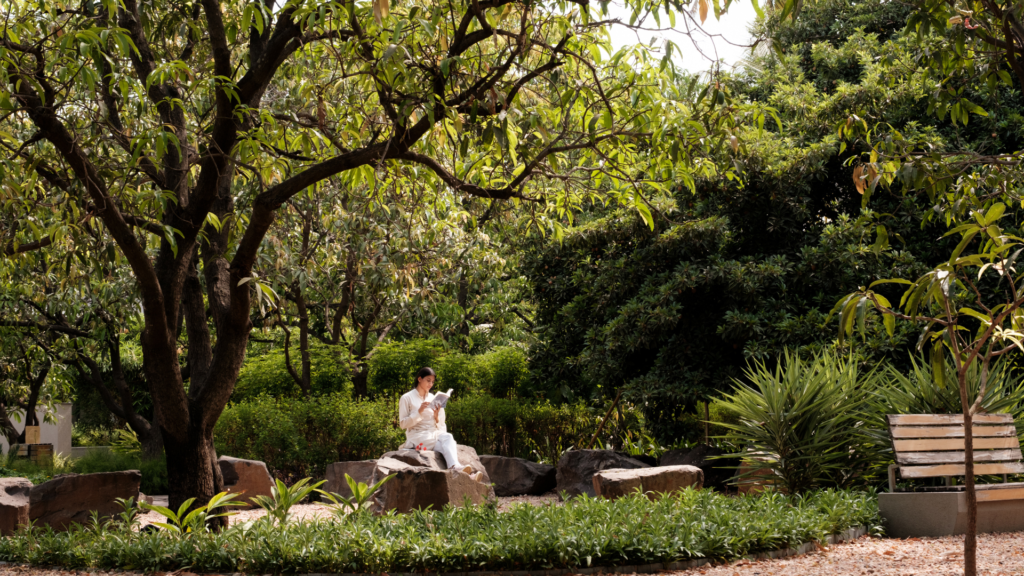
Feature image courtesy: Khyati Sanger


Thank you for following my blog and associated podcast.
Pingback: How Sepia Snapshots Evoke Newfound Memories – The Thought Behind